What Makes NCSS Special
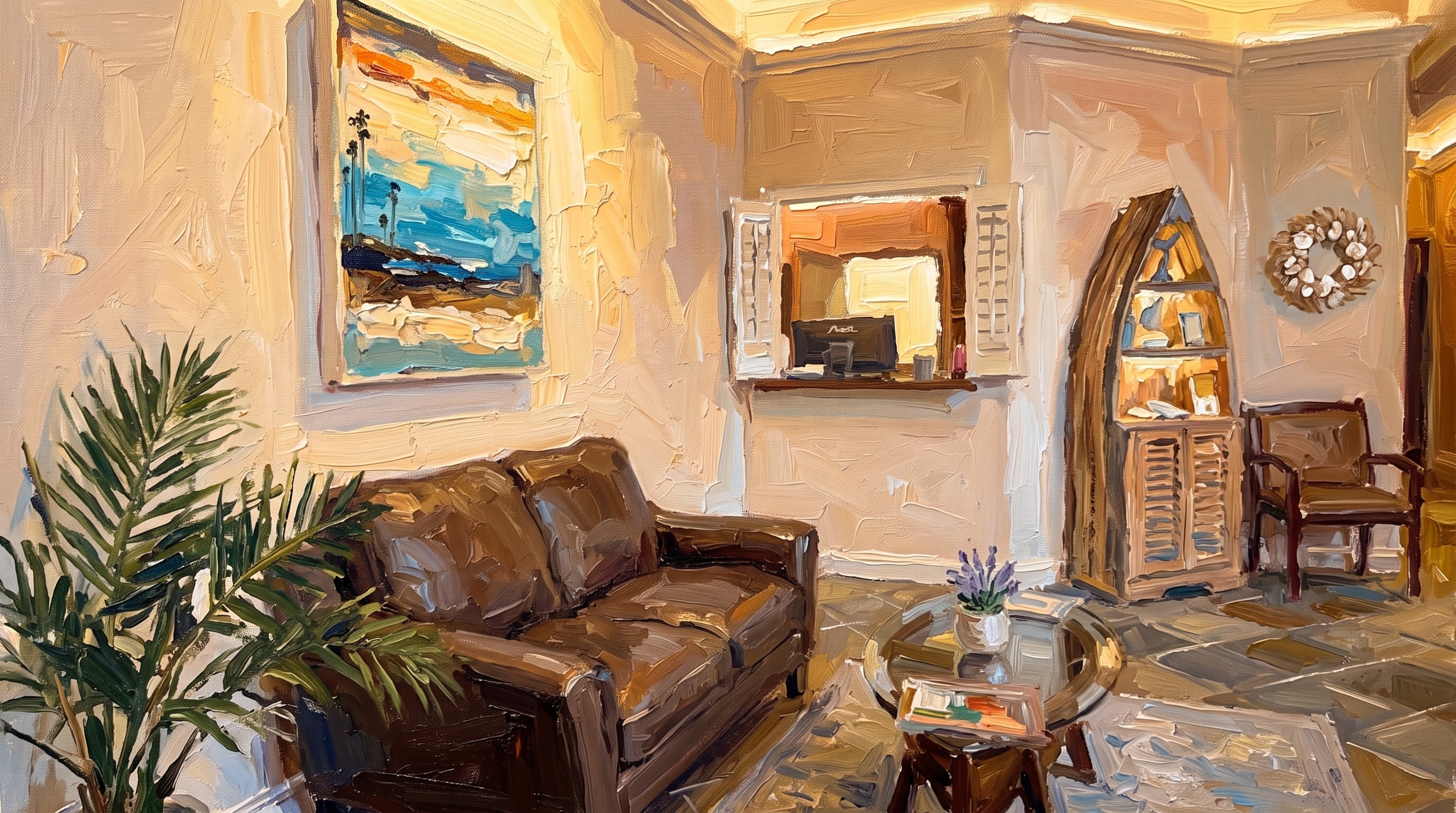
What makes NCSS special.
'What makes you special' is a question every medical facility must answer. For us it's in the name. Our entire focus is to treat you like we would want to be treated. That stands as the basis for everything we do. It's not a new or revolutionary concept, but it has been largely lost in the corporate medicine of today.
NCSS Waiting Room · plein-air study
NCSS Waiting Room · plein-air study
If you have visited the websites of enough plastic surgery facilities, you know the pattern of the 'what makes us different' page. State-of-the-art equipment. Compassionate staff. Personalized care. Highest safety standards. Beautiful facility. The vocabulary is nearly identical from site to site. The paragraphs blur together.
We resisted writing this page for a long time. Not because we don't believe NCSS is different — we do, or we would not have built it — but because 'what makes us special' is a category of marketing writing that has been so devalued by overuse that any straightforward version of it feels dishonest.
But the question comes up. Patients ask it. Referring physicians ask it. So here is the answer, given as plainly as we know how.
It is not one thing.
The answer isn't a single feature. If we had to pick one feature to defend as most important, we would probably pick physician-only anesthesia — the subject of an earlier piece in this Journal. But physician-only anesthesia is not what makes NCSS special by itself. It is one component of an operational profile, and it is that profile — the combination — that is unusual. The individual components are:
- Physician anesthesia on every case. No CRNAs on staff. A board-certified anesthesiologist personally delivers every anesthetic from induction through emergence.
- One-to-one nursing. From the moment you arrive to the moment you are discharged, one nurse is with you. Not a hand-off between pre-op, intraop, and post-op nursing pools. One nurse, your case.
- Private recovery suites. No shared bays. No drapes between you and other patients. You wake up in your own room and recover in privacy.
- Plastic surgery only. No colonoscopies. No orthopedic cases. No gynecology. The operating rooms, recovery suites, and sterile-processing workflow are designed for plastic surgery and nothing else — and free of the infection sources typical of mixed-scope centers.
- Physician-owned. Owned by physicians, operated by physicians, staffed by physicians. Not owned by a private equity fund, not part of a hospital system, not a chain.
- Affiliated-surgeon roster. Nine independent surgeons who each run their own practice and choose to operate here. Not employees. Not exclusive contracts. Selection by choice, on both sides.
- Free personal pre-op consultation with the medical director. Every scheduled surgical patient is offered a Rest-Assure evaluation with Dr. Scott personally — anesthesia planning, medication review, discharge coordination. Personal, not administrative.
- Zero hospital transfers from our facility, ever. Thirty years, zero emergency transfers. This is a fact, not a slogan.
- First floor, free parking, private side exits, pharmacy and lab across the hall. The location works for surgical patients specifically.
- Fewer cases per day than a volume-optimized facility. By design.
Each of these items is available somewhere. Physician-only anesthesia exists at some centers. Plastic-only scope exists at others. Private recovery exists at hotel-associated surgical suites. Physician ownership exists at facilities that resisted being acquired. What is rare is finding them all together in one place, at operating scale, in Orange County.
Most of it is not new.
This is the part that surprises patients most. Everything on the list above was, in 1996, the standard for high-end outpatient surgical facilities. We did not invent this operating profile. We adopted the standard that then existed and never modified it.
Since 1996, the outpatient surgery industry has systematically unbundled these features to hit lower price points and higher case volumes. CRNAs replaced physician anesthesiologists at most centers because CRNAs cost less per case. Bay-based recovery replaced private suites because bays fit more patients per square foot. Mixed-specialty scope became the norm because it maximizes room utilization across the day. Private equity acquired thousands of independent surgical centers and standardized their operating models around margin.
What makes NCSS unusual is not that we are ahead of the industry. It is that we are behind it, deliberately, on the specific dimensions we decided mattered enough to keep.
None of this is villainy. It is rational business behavior in an industry with tight margins and consolidating ownership. Most of the facilities that unbundled did so because staying in business required it, or because their owners believed they could deliver acceptable outcomes at lower cost. They may be right. They are certainly the mainstream.
Sweating the small stuff. The difference between great and mediocre.
A common assumption about a facility like NCSS is that all of this must cost more. It does not. Our facility fees are typically lower than other surgical centers in Newport Beach — sometimes materially lower. What is unusual about us is not the price. It is what the price is spent on.
The industry expression for what makes surgery excellent versus adequate is sweating the small stuff. Every clinical process has a version that is done merely correctly and a version that is done attentively. The difference is rarely dramatic, and it rarely shows up in a single decision. It shows up in the accumulation of small decisions across a case — the same way the difference between great and mediocre shows up in any part of life.
Some of the small stuff at NCSS:
- Pre-op warming. The temperature of the warming blankets, the timing of when they are applied, and how they interact with the patient's core temperature at induction. Warmer patients tolerate anesthesia better and need less of it.
- Nausea prevention. Multiple pharmacologic agents, given at specific times relative to induction, rather than the reactive treatment that is the default at many facilities.
- The patient greeting. Someone greets you when you arrive. Not because it looks nice — because arriving at a surgical facility is disorienting, and a name and a face at the beginning of the day changes how the whole day feels.
- IV placement. Gauge, location, and technique. Done by the anesthesiologist, not a rookie nurse. Cooling spray to minimize discomfort. A single competent attempt is typical, and we use the smallest gauge that will do the job.
- A warm, private pre-op room. Cloth, not paper gowns. When you are dressed in a gown, the room is warm. You have privacy to be candid with the surgical team. The OR temperature is cold to minimize infection risk, but we keep you warm with heated air circulating over you during the procedure. This is not a small thing during a long case.
- Sterile-processing turnaround. How long instruments stay wet between rinse and sterilization, what water is used, what protocols run in the autoclave. All governed by AAAHC standards.
- The post-op call. Your surgeon calls you the night of your surgery. Not the next morning; that night. If you have a question at 8 p.m., you do not wait until 9 a.m.
- Discharge instructions. Verbal instructions given in non-medical terms. We strive to tell you why we are asking you to do something — patients who understand why are much more likely to follow the instructions. And yes, there are written instructions to take home with you. If you leave here confused about what to do at home, we did not do our job.
None of these is a single dramatic feature. Each is one small decision. Made attentively and consistently across every case, every day, for thirty years, they add up to a surgical experience that patients notice — and often cannot articulate what specifically was different, only that something was.
This is what 'the difference between great and mediocre' looks like in surgical practice. It is not equipment. It is not credentials alone. It is the accumulation of small decisions made attentively rather than adequately. That, above all else, is what we spend our attention on.
The competitive facility fees — typically lower than the alternatives in Newport Beach — are the direct result of thirty years of operating this way. Physician-owned, physician-operated, plastic-surgery-only. Without private equity extractions. Without hospital-system overhead. Without the marketing spend that other centers carry. Small facility. Big attention.
What it means for a patient.
If you have surgery at NCSS, you get:
The anesthesia of a hospital operating room, delivered by a physician who is present in the room throughout your case.
The nursing continuity of a private-duty arrangement, at outpatient prices.
The privacy of a hotel suite for your recovery.
The clinical focus of a facility that does one specialty and nothing else.
The pre-operative attention of a medical director who wants to meet you personally before you fall asleep.
These are not new features. They are what surgical facilities used to be. What is uncommon is that they still are, in this one facility, in 2026.
That is the answer to the question. It is not clever. It is not proprietary. It is a set of choices we made in 1996 and have not changed. Whether it matters to you depends on how much these specific attributes matter to your idea of what surgery should feel like. For patients who care about them, we exist for exactly this reason. For patients who do not — for those who want competent surgery without the small-stuff attention — there are other facilities. Either choice is defensible. Both are honest. The only question, really, is which one fits you.
H. Rand Scott, MD is founder and Medical Director of Newport Center for Special Surgery. Board-certified anesthesiologist, subspecialty training in interventional pain management at Penn State Milton S. Hershey Medical Center. He personally offers a free Rest-Assure pre-operative consultation to every scheduled surgical patient at NCSS.
Related reading.
The facility and the model.
The facility, the physician-owned model, and the operational standards that support the affiliated roster.
Read more →Rest-Assure perioperative care.
The perioperative standard that defines NCSS — physician anesthesia, one-to-one nursing, and the medical-director consultation.
Read more →Return to the Journal.
Return to the Journal to see what else is written and what is next.
Read more →